Koh Samui Beaches Guide 2026: Chaweng, Lamai and Maenam Explained
Koh Samui covers about 229 square kilometres, making it Thailand's third-largest island, with a 51 km ring road that takes about 1.5 hours to drive. The beaches concentrate on the east and north coasts, with the 8 main stretches 3 to 12 km apart and differing mainly in sand, gradient and service density.
The beaches read as 3 stretches: Chaweng and Lamai on the east coast have the densest services and more noticeable swell; Bophut, Big Buddha and Maenam on the north coast shelve gently and sit near the piers for Koh Phangan; Lipa Noi and Taling Ngam on the west and southwest are quietest and are the island's sunset side.
2026 seasons: the rains fall October to December
Samui sits in the Gulf of Thailand, so its rain concentrates from October to December with November the wettest, offset from Phuket on the Andaman side. January to April is driest with swell mostly under 0.5 metres, and May to September brings occasional showers but steady swell. Island-hopping and snorkelling cancellations rise in the rainy season. Check the month's rainfall forecast first.
Beach conditions: Chaweng longest at 7 km, Choeng Mon gentlest
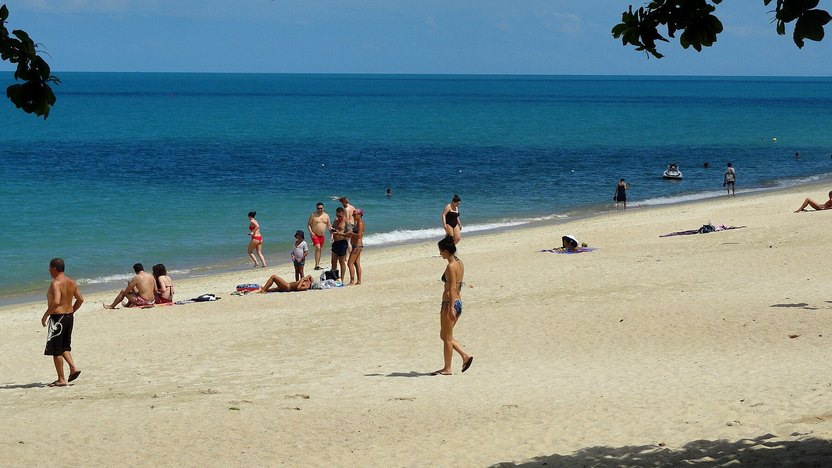
Chaweng runs about 7 km and 20 to 40 metres wide, the longest stretch on the island; Lamai runs about 4 km with coarser sand; Maenam runs about 4 km with cloudier water but the most quiet. The gentlest gradients are at Choeng Mon and Lipa Noi, where water under 1 metre deep often extends 40 metres or more. Confirm water conditions against the flags and signage on site.
Swimming safety: offshore reef and the jellyfish months
The middle of Chaweng and the northern end of Lamai have offshore reef, where water drops under 50 cm at low tide over broken coral, so rubber-soled water shoes are advisable. Red flags bar swimming at some beaches as swell rises from October to December, and box jellyfish are reported in a few months. Confirm the flags and signage on site before entering the water.
Reaching Koh Samui: 4 options and what they cost
Samui is reached by direct flight or by ferry via Surat Thani. The island has no rail network, so moving around means songthaews, ride-hailing, rented scooters or a charter. The ring road is mostly single-lane and the peak falls between 17:00 and 19:00. Confirm fares against current station notices.
Flights: 1 hour direct from Bangkok, about 20 a day
Bangkok's two airports together run about 20 flights a day to Samui with a flight time of about 1 hour, and the airport sits 10 minutes by road from Chaweng at about 300 to 500 baht. Samui airport is privately run with fewer routes, so fares commonly exceed the connecting options. Confirm fares and schedules against the airline notice.
Combined bus and ferry tickets: 12 to 14 hours in total
Combined tickets from Bangkok's southern bus terminal cover the coach and the ferry at about 900 to 1,400 baht per person, mostly departing between 18:00 and 19:00 and arriving around 07:00 the next day, 12 to 14 hours in total. The ferry leaves from Don Sak pier in Surat Thani, taking 1.5 hours. Confirm fares and departures at the terminal.
Island songthaews: 50 to 100 baht a trip
Songthaews run the ring road without meters, at about 50 to 100 baht per person from Chaweng to Lamai or about 100 to 150 baht to Maenam, with surcharges above 50 baht common after 22:00. State the destination and agree the fare before boarding, as vehicles thin noticeably at night. Confirm the fare before boarding.
Scooter rental and charters: 200 baht and 1,500 baht a day
A 125cc scooter runs about 200 to 250 baht a day against a passport, with an international permit required and some ring-road gradients over 15%. A 4-seat charter runs about 1,500 to 2,000 baht for 8 hours and covers the ring road's sights in one go. Ride-hailing coverage on the island is limited and night waits often exceed 15 minutes. Confirm rates and quotes against each operator's notice.
Koh Samui's beaches in 2026: 8 stretches explained
These are ordered from the east coast through the north to the west, each with its length and service density. Hours and prices can change, so confirm each venue's notice on site.
Chaweng Beach: 7 km with the most complete services
Chaweng runs about 7 km and 20 to 40 metres wide, the best-served stretch on the island, with about 200 restaurants and shops along the sand mostly trading past 23:00. The middle section has an offshore reef where water drops under 50 cm at low tide over broken coral.
The northern end is deeper and suits swimming; the middle has the densest commerce and the island's top rate band; the southern end is quieter. Beach chairs rent for about 100 to 200 baht including an umbrella. Confirm prices and trading hours on site.
Lamai Beach: 4 km with rock formations to the south
Lamai runs about 4 km with coarser sand than Chaweng, about 100 places to eat and prices about 15% below Chaweng. A group of natural sandstone stacks sits 2 km south and is the island's most photographed spot, about 150 metres along a path from the car park. Entry is free.
The northern end exposes reef at low tide and does not suit swimming, while the middle and south shelve more gently. About 30 massage shops line the sand, at about 300 to 400 baht an hour. Confirm prices and trading hours with each venue.
Bophut and Fisherman's Village: a Friday walking street
Bophut runs about 2 km with cloudier water, and the Fisherman's Village behind the sand is a dining street converted from 2-storey timber buildings with about 60 venues. Each Friday from 17:00 the road closes as a walking street, with stalls extending about 400 metres and the crowd tightest from 19:00 to 21:00.
The beach shelves gently and suits walking rather than snorkelling. Chaweng is 10 minutes by road and the airport 10 minutes. Walking-street dates and hours shift with the season, so confirm on site.
Big Buddha Beach: where the Koh Phangan pier sits
Big Buddha Beach runs about 2.5 km on the eastern part of the north coast, named after the seated image about 12 metres high nearby. The speedboat pier for Koh Phangan sits on the beach, at 30 to 40 minutes one way for about 300 to 500 baht.
The beach exposes about 100 metres of mudflat at low tide and does not suit swimming, serving mainly as a transport node and a sunrise viewpoint. About 40 places to eat nearby mostly close by 22:00. Confirm fares and trading hours against the pier and venue notices.
Maenam Beach: the quietest long beach on the north coast
Maenam runs about 4 km and 15 to 25 metres wide, the quietest stretch on the north coast, with lodging mostly small and mid-size hotels of 2 floors or fewer. It sits 2 km and 5 minutes by road from Maenam pier for Koh Phangan, one of the shortest island-hopping runs among the lodging areas.
The water is cloudier and the swell gentle, with better visibility from January to April. About 50 places to eat mostly close by 22:00, with 3 convenience stores. Confirm hours with each venue.
Choeng Mon Beach: the gentlest bay, built for families
Choeng Mon sits on the island's northeast corner, about 1.5 km long in a half-enclosed bay, where water under 1 metre deep often extends 40 metres or more and a small island about 200 metres offshore can be walked to at low tide. It is the gentlest gradient on the island.
Swell stays steady year-round, which suits small children. About 25 places to eat are mostly attached to hotels, so evenings mean a ride into Chaweng. Chaweng is 10 minutes by road. Confirm hours with each venue.
Lipa Noi: sunset and shallow water on the west coast
Lipa Noi runs about 4 km on the west coast facing Surat Thani and is the island's main sunset side. At low tide the band under 50 cm deep extends about 150 metres, so it is possible to walk well offshore.
About 20 places to eat along the sand mostly close by 21:00, and lodging is mostly resorts. Nathon, the main pier, is 15 minutes by road and Chaweng 40 minutes. Confirm hours with each venue.
Taling Ngam: elevated sea views in the southwest
Taling Ngam sits on the southwest coast with about 2 km of coarser sand, backed by slopes rising 50 to 150 metres where lodging is mostly resorts built up the hillside with rooms above the level of the sand. It has the lowest lodging density on the island.
The beach does not suit swimming and works mainly as a viewpoint. About 10 places to eat sit nearby, and evening trips need a charter, with Chaweng 45 minutes by road. Confirm drive times and trading hours on site.
What Koh Samui's beaches cost: the price structure
The beaches themselves are free, so spending falls into 3 categories: equipment rental, water sports and island trips. The ranges below are typical and move with the season, so confirm each venue's notice on site.
Rentals: beach chairs 150 baht, massage 350 baht
Beach chairs at Chaweng and Lamai rent for about 100 to 200 baht including an umbrella, and some hotel frontages are reserved for guests. An hour of massage on the sand runs about 300 to 400 baht and 30 minutes of foot massage about 200 baht. A kayak runs about 300 baht an hour. Confirm prices against the notices on site.
Water sports and island trips: 1,500 baht for a snorkelling day
A day trip to Ang Thong Marine National Park runs about 1,500 to 2,200 baht per person excluding the park fee of about 300 baht, leaving at 07:30 and returning at 17:00. Koh Phangan runs about 300 to 500 baht one way and Koh Tao about 600 to 900 baht. Cancellations rise from October to December. Confirm prices and inclusions against the operator's notice.
Where to stay on Koh Samui: picking a zone by beach
The zone decides evening movement and swimming conditions: Chaweng for services, Maenam or Choeng Mon for quiet, the west coast for sunsets, the north coast for island trips. Chaweng to Maenam takes about 25 minutes, so confirm drive times against the day's traffic.
The Chaweng area: the densest dining and nightlife
Chaweng has about 200 restaurants and shops along the sand mostly trading past 23:00, the only zone that needs no vehicle at night. The trade-offs are the island's top rate band in high season, broken coral in the middle section at low tide, and traffic and amplified music on some stretches at night. Confirm live rates on your booking platform.
Maenam and Choeng Mon: quiet and close to the piers
Maenam sits 2 km and 5 minutes by road from the Koh Phangan pier, while Choeng Mon has the gentlest gradient for small children, and rates in both mostly run 15% to 25% below Chaweng. The trade-offs are about 25 to 50 places to eat in each, mostly closing by 22:00, which means a ride at night. Confirm hours with each venue.
Sequencing: calmest water in the morning, keep a spare day in the rainy season
For snorkelling and island trips, book the 07:30 to 08:30 departure, as mornings are usually calmest. From October to December, keeping 1 spare day leaves room to reschedule, and Ang Thong belongs early in the trip. Confirm the day's sailings with the operator.
Kit and safety: 2 litres of water and rubber-soled shoes
Shade on the beaches is limited, so a hat, a long-sleeved sun top and 2 litres of water or more are worth packing. The middle of Chaweng and the northern end of Lamai hold broken coral at low tide, so rubber-soled water shoes are advisable. Songthaews thin at night, so allow 20 minutes of waiting after 22:00. Confirm the flags and signage on site before entering the water.
FAQ
Q. How do Chaweng, Lamai and Maenam compare?
It depends on the need. Chaweng runs 7 km with the densest dining and nightlife and the highest rates; Lamai runs 4 km at prices about 15% lower, with rock formations at its southern end; Maenam runs 4 km, sits 2 km from the pier for Koh Phangan and is the quietest. Confirm live rates on your booking platform.
Q. When is the rainy season on Koh Samui?
Samui sits in the Gulf of Thailand, so its rain concentrates from October to December — the opposite of Phuket on the Andaman side — with November the wettest month of the year. January to April is driest, with swell mostly under 0.5 metres. Check the month's rainfall forecast before setting out.
Q. Can a scooter be rented without a licence?
Not advisable. The ring road runs 51 km with some gradients over 15%, police run checkpoints around Chaweng and Lamai, and riding without an international permit commonly draws a fine of 500 to 1,000 baht. A songthaew or a ride-hailing app is the steadier option. Confirm penalties and fees against current enforcement notices.
Q. What is the cheapest way from Bangkok to Koh Samui?
Flying direct takes about 1 hour but costs more; a combined bus-and-ferry ticket runs about 900 to 1,400 baht over 12 to 14 hours. Flying to Surat Thani and transferring by road and boat takes about 5 hours in total. Confirm fares and schedules against airline and station notices.
Q. Which stretch suits children?
Choeng Mon and Lipa Noi shelve most gently, with water under 1 metre deep often extending 40 metres or more and shallower at low tide. The middle of Chaweng has an offshore reef and broken coral underwater in places. Conditions differ daily, so confirm the flags and signage on site before entering the water.
Q. Are Koh Phangan or Koh Tao workable as day trips?
Koh Phangan is, at 30 to 40 minutes one way from Maenam or Big Buddha pier for about 300 to 500 baht. Koh Tao is 1.5 to 2 hours one way, which leaves only about 4 hours ashore on a same-day return, so a night there works better. Confirm fares and departures against the pier notice.