Chiang Mai Temples Guide 2026: Doi Suthep, Wat Phra Singh and Wat Chedi Luang Explained
Chiang Mai was founded in 1296, and its old city is a square about 1.5 km a side, with roughly 30 surviving temples inside the 2.25 square kilometres ringed by the moat. Doi Suthep on the mountain sits 15 km out, about 40 minutes by road, and is the only stop on the main route that involves a climb. First-time visitors can cover the three old-city temples plus Doi Suthep in 1 day, or 2 days with Wat Umong and the silver temple added.
The temples form 3 rings. The first is Wat Phra Singh, Wat Chedi Luang and Wat Phan Tao inside the walls, within 600 metres of each other on foot. The second is Wat Chiang Man, Wat Lok Moli and Wat Suan Dok outside the walls, within 10 minutes by road. The third runs west up Doi Suthep and takes in Wat Pha Lat and Doi Suthep itself, 15 km one way.
2026 tickets and hours: 50 baht at each of the three old-city temples
Wat Phra Singh costs 50 baht and opens 08:00 to 17:00; Wat Chedi Luang 50 baht, 08:00 to 17:00; Wat Phan Tao 50 baht, 08:00 to 17:30. Doi Suthep costs 50 baht and opens 06:00 to 20:00; Wat Chiang Man 50 baht, Wat Suan Dok 20 baht and the silver temple 50 baht, while Wat Umong and Wat Lok Moli are free with voluntary donations. Prices and ticketing hours can change, so confirm each temple's official notice.
Routing: 1.2 km on foot across the three old-city temples
Wat Phra Singh stands at the west end of Ratchadamnoen Road inside the old city, 800 metres and 11 minutes east on foot to Wat Chedi Luang; Wat Phan Tao is 150 metres and 2 minutes north of that, sharing the same entrance area. The three total about 1.2 km on foot, with continuous shade along Ratchadamnoen Road. A further 700 metres north reaches Wat Chiang Man.
Dress code: shoulders and knees covered, shoes off indoors
The three old-city temples and Doi Suthep all require covered shoulders and knees, and sleeveless tops, shorts and above-the-knee skirts are turned away at the hall doors. Doi Suthep and Wat Phra Singh rent sarongs at the entrance against a deposit of about 20 to 50 baht, returned on handover. Shoes come off in every hall, pointing the soles of the feet at an image is prohibited, and women may not hand objects directly to a monk. Confirm the current rules on site.
Reaching Chiang Mai's temples: 4 options and what they cost
Chiang Mai has no rail network, so temple trips run on red songthaews, rented scooters, ride-hailing and charters. The old city is 1.5 km a side and works on foot, while Doi Suthep needs a vehicle. Peaks fall between 07:30 and 09:00 and 16:30 and 18:30, when the Nimmanhaemin area is slowest. Confirm the fare agreed before boarding.
Red songthaews: 30 to 40 baht a trip in the old city
Red songthaews run as shared rides, at about 30 to 40 baht per person inside the old city and nearby, or about 40 to 60 baht to Nimman. Flag one down, state the destination, and board once the driver nods; sharing works only on a similar route and a detour is refused. A 20 baht surcharge is common after 22:00. Confirm the fare before boarding.
Up to Doi Suthep: 150 to 200 baht return by songthaew
Songthaews at Chang Phuak Gate and outside Wat Phra Singh run shared trips up the mountain at about 150 to 200 baht per person return, departing once 8 to 10 passengers fill, with waits often 20 minutes and time at the top mostly counted as 60 minutes. The road covers 15 km and 18 bends one way, about 40 minutes. Confirm departure terms and fares when agreeing them on site.
Scooter rental: 200 to 300 baht a day
About 50 rental shops ring the old city, with 125cc scooters at about 200 to 300 baht a day against a passport or 2,000 baht, and an international permit required. Doi Suthep is 15 km one way with about 1,000 metres of climb, and surfaces are slippery in the rainy season, so the climb does not suit first-time riders. Confirm rates and deposit terms against each shop's notice.
Charters and ride-hailing: 1,200 to 1,500 baht a day
A 4-seat charter runs about 1,200 to 1,500 baht for 8 hours and chains Doi Suthep, Wat Pha Lat and Wat Suan Dok in one go. Ride-hailing from the old city to Doi Suthep runs about 350 to 500 baht one way, but rides are hard to find for the return, so either keep the driver waiting or take a songthaew down. Quotes move by time of day, so confirm the live quote in the app.
The 10 Chiang Mai temples worth your time in 2026
These are ordered by the 3 rings — inside the walls, outside them and up Doi Suthep — each with its entry fee and distance. Fees and hours can change, so confirm each temple's official notice.
Doi Suthep: 1,073 metres and a 306-step naga stairway
Wat Phra That Doi Suthep was founded in 1383 at 1,073 metres on Doi Suthep, and its main stupa stands about 24 metres clad entirely in gold leaf, the highest-ranking royal stupa of the Lanna kingdom. The naga stairway from the gate to the stupa terrace covers 306 steps and about 60 metres of height, flanked by ceramic serpents about 150 metres long. Entry costs 50 baht.
Hours run roughly 06:00 to 20:00. A funicular replaces the climb at about 30 to 50 baht one way over 2 minutes. The terrace faces the city and on clear days reaches the airport runway 25 km away, while February to April haze often leaves 2 to 3 km of visibility. Confirm prices and running times on site.
Wat Phra Singh: the old city's largest temple, founded in 1345
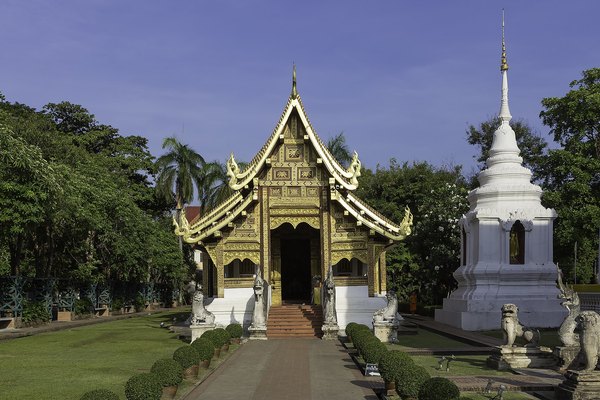
Wat Phra Singh was founded in 1345 by the fifth Lanna king and occupies the largest grounds inside the old city, about 40,000 square metres. The small Lai Kham hall behind the main building is original to 1345, and its murals depict 19th-century Lanna life. Entry costs 50 baht.
Hours run roughly 08:00 to 17:00. A monk-chat desk operates in the grounds, mostly 09:00 to 17:00 and free to join. During Songkran in April a water-pouring area is set up in the forecourt, with crowds concentrated from 13:00 to 16:00. Hours shift with the temple's rota, so confirm the notice on site.
Wat Chedi Luang: the remains of an 82-metre stupa
The main stupa at Wat Chedi Luang stood about 82 metres when completed in 1441, the tallest structure in Lanna at the time, and lost its upper half in an earthquake in 1545, leaving about 60 metres on a base 54 metres a side. During 1990s restoration, 5 stucco elephants were added on the east face, and the original brickwork was left unpainted. Entry costs 50 baht.
Hours run roughly 08:00 to 17:00. The base is fenced and cannot be climbed, and women may not enter the inner ring on the stupa's north side. Confirm current hours on site.
Wat Phan Tao: a teak hall converted from monks' quarters
The main hall at Wat Phan Tao rests on 28 teak columns and served as 19th-century royal monks' quarters before conversion into a hall in 1876, making it the only surviving large all-teak building in Chiang Mai. The gable inside carries gilded carvings of peacocks and dogs, with a lintel about 3 metres high. Entry costs 50 baht and Wat Chedi Luang is 2 minutes on foot.
Hours run roughly 08:00 to 17:30. During the November lantern festival about 500 oil lamps are lit around the courtyard pond, and photography queues of about 15 minutes are common between 18:00 and 21:00. Festival dates follow the lunar calendar each year, so confirm against the temple notice.
Wat Chiang Man: the oldest temple, founded with the city in 1296
Wat Chiang Man dates to 1296, the year the city was founded, making it the oldest surviving temple inside the walls, and it served as King Mangrai's temporary residence. Its elephant stupa stands about 15 metres on a base ringed by 15 stucco elephants. Entry costs 50 baht.
Hours run roughly 08:00 to 17:00. It sits in the old city's northeast corner, 700 metres and 10 minutes on foot from Chang Phuak Gate, making it the easiest addition across the 3 rings. A full visit takes about 25 minutes. Confirm current hours on site.
Wat Umong: 700 metres of tunnel murals
Wat Umong was founded in 1297 in woodland on the eastern foothills of Doi Suthep, across grounds of about 15 hectares. Its core is a set of man-made tunnels about 700 metres in total with 2 metres of headroom, where fragments of 14th-century murals survive. Entry is free, with voluntary donations.
Hours run roughly 06:00 to 17:00. It lies 5 km southwest of the old city, 15 minutes by road, with no fixed songthaew route, so a ride-hailing app is the practical option. An English-language meditation session runs Sundays at 15:00 for about 90 minutes. Confirm session times against the temple notice.
Wat Suan Dok: a group of white royal stupas
Wat Suan Dok was founded in 1370 on the site of a royal garden outside the old city's west gate, and about 30 white stupas in its courtyard hold the ashes of successive Lanna royals, the tallest about 48 metres. Entry costs 20 baht.
Hours run roughly 06:00 to 17:00. It sits 1.5 km west of Wat Phra Singh, 6 minutes by road, and 15 minutes on foot from the Nimman shopping district. The 40 minutes before sunset give the weakest backlight on the white stupas. Confirm prices and hours on site.
Wat Lok Moli: a Lanna brick stupa outside the north gate
Wat Lok Moli dates to the 14th century, and its main stupa is unfaced red brick about 20 metres high, the best-preserved original brickwork in Chiang Mai, holding the ashes of 3 Lanna kings. Entry is free.
Hours run roughly 08:00 to 18:00. It stands 200 metres outside the old city's north gate, 3 minutes on foot, and pairs with Wat Chiang Man on a 1.1 km walking route. There is no ticket booth, and the donation box sits at the main hall entrance. Confirm current hours on site.
The silver temple: a main hall clad in silver
Wat Sri Suphan stands in the Wua Lai silversmith quarter outside the old city's south gate, with its main hall clad inside and out in hand-worked silver and aluminium sheet, carrying about 200 square metres of relief work, the only fully silver-faced hall in Thailand. Entry costs 50 baht.
Hours run roughly 08:00 to 17:30. By Lanna tradition the main hall is open to men only, while women can view the exterior reliefs and the courtyard. The Saturday Wua Lai walking street opens at 17:00 and the temple front is the market entrance. Confirm prices and hours on site.
Wat Pha Lat: an hour on the monk's trail
Wat Pha Lat sits halfway up Doi Suthep at about 600 metres as the staging temple on the way to Doi Suthep, reached from the trailhead behind Chiang Mai University by about an hour on the monk's trail, covering 1.5 km and 300 metres of climb. Entry is free.
Hours run roughly 06:00 to 18:00. The trail is earth and rock, slippery and full of ants from May to October, so closed shoes are advisable. Skipping the trail means driving straight to the car park in front, about 20 minutes. Confirm current hours against the temple notice.
What Chiang Mai's temples cost: tickets and rentals
Spending splits into 3 categories: tickets, rentals and transport. The three old-city temples total 150 baht, about 85% below Bangkok's old town. The ranges below are typical and move with the season, so confirm at each temple's ticket office before buying.
Tickets: 150 baht for the three, about 340 baht for all 10
Wat Phra Singh, Wat Chedi Luang and Wat Phan Tao cost 50 baht each, 150 baht for the three. Adding Doi Suthep at 50 baht, Wat Chiang Man at 50 baht, Wat Suan Dok at 20 baht and the silver temple at 50 baht brings all 10 to about 340 baht; Wat Umong, Wat Lok Moli and Wat Pha Lat are free. Booths mostly take cash and not mobile payment. Confirm prices against each temple's notice.
Rentals and guiding: sarongs 20 baht, funicular 50 baht
Sarong rental at the entrances takes a deposit of about 20 to 50 baht, returned on handover. The Doi Suthep funicular costs about 30 to 50 baht one way. None of the three old-city temples offers an audio guide, and on-site guiding is mostly done by charter drivers at about 300 to 500 baht for half a day. "Free guiding" offered by touts outside the gates commonly charges as a donation, so confirm at the temple counter. Confirm rental costs against the notices on site.
Where to stay for Chiang Mai's temples: picking a zone by route
The zone decides the morning entry and the climb: inside the old city to walk the three temples, Nimman to combine cafés with the mountain, Tha Phae Gate for night markets. The old city to Doi Suthep takes about 40 minutes, so confirm drive times against the day's traffic.
Inside the old city: three temples within a 10-minute walk
Old-city lodging is mostly converted houses of 3 floors or fewer and small hotels, within 10 minutes on foot of Wat Phra Singh and Wat Chedi Luang, which allows entry with the first group when gates open at 08:00. The trade-offs are evening food that mostly closes by 22:00, few parking spaces and some lanes under 3 metres wide; confirm hours with each venue. It suits heritage-focused stays of 3 nights or fewer.
The Nimman area: shortest run to the mountain and the cafés
The Nimman district sits 1.5 km from Wat Phra Singh, 6 minutes by road, and only 3 km from the Doi Suthep trailhead, the shortest run to the mountain. Café density is the city's highest, often more than 30 on a single stretch, mostly opening at 08:00. The trade-offs are rates about 20% above the old city and temples needing a separate ride. Confirm live rates on your booking platform.
Timing: enter at 08:00, avoid the 10:00 group peak
The three old-city temples open at 08:00 and arriving before 08:30 mostly clears the tour groups, which concentrate from 10:00 to 13:00, when the area in front of the Wat Chedi Luang stupa is tightest. Doi Suthep opens at 06:00, and going up before 07:30 gives the thinnest crowds and weaker backlight. Confirm hours against each temple's notice.
Climate and kit: haze February to April, 10°C on the mountain in the cool season
February to April is the haze season, when mountain visibility often drops to 2 or 3 km; in the November to January cool season the mountain can reach around 10°C at dawn while the old city still hits 28°C by day, so a light jacket helps. From May to October afternoon storms concentrate between 15:00 and 18:00 and stone steps turn slippery. Shoes come off indoors, so slip-on styles and a cloth bag help. Check the day's air quality and rain forecast before setting out.
FAQ
Q. Do Chiang Mai's temples fit into one day?
Wat Phra Singh, Wat Chedi Luang and Wat Phan Tao sit within 600 metres of each other inside the old city and link up in a 15-minute walk, so 3 hours in the morning is enough. Doi Suthep lies 15 km west, about 40 minutes by road, which suits the afternoon or the next morning. Confirm hours with each temple.
Q. What is the cheapest way up to Doi Suthep?
Red songthaews around Chang Phuak Gate run as shared rides at about 150 to 200 baht per person return, departing once 8 to 10 passengers fill, with waits often 20 minutes. Ride-hailing runs about 350 to 500 baht one way. Fares shift with numbers and season, so agree the price before boarding.
Q. Are the 306 steps at Doi Suthep unavoidable?
No. A funicular beside the gate runs about 30 to 50 baht one way over about 2 minutes, straight to the stupa terrace. The naga stairway covers 306 steps and about 60 metres of height with no shade in the middle, and the stone turns slippery after rain. Confirm funicular prices and running times on site.
Q. What is the dress code at Chiang Mai's temples?
Shoulders and knees must be covered throughout, and sleeveless tops, shorts and short skirts are turned away at the hall doors. Doi Suthep and Wat Phra Singh rent sarongs at the entrance against a deposit of about 20 to 50 baht; shoes come off in the halls, where pointing the soles of the feet at an image is prohibited. Confirm the current rules on site.
Q. Which months are poor for going up Doi Suthep?
February to April is the haze season, when agricultural burning cuts mountain visibility and the summit view often drops to 2 or 3 km. In the November to January cool season the mountain can fall to around 10°C at dawn, so a jacket is worth packing. Check the day's air quality and temperature before setting out.
Q. Does talking with monks at the old-city temples cost anything?
No. Wat Phra Singh and Wat Chedi Luang run monk-chat desks, mostly open 09:00 to 17:00 and free to join, where women must keep at least 1 metre back and may not hand objects directly to a monk. Hours shift with the temple's rota, so confirm the notice on site.